
A Cough That Didn’t Go Away
August 5, 2026

Felipe had spent his entire life focused on how the body works and how to keep it working well. With a background in exercise physiology and injury prevention, his career was built around helping people recover, rebuild, and, whenever possible, avoid injury altogether. So, when something didn’t feel right in his own body, it stood out immediately.
In 2019, Felipe was running a half marathon with 2 clients when he noticed a cough that felt different from anything he had experienced before.
“I couldn’t catch my breath, which was very unlike me,” he said. “People were actually stopping and asking if I was okay.”
He finished the race, but the symptoms stayed. He was diagnosed with chronic bronchitis and asthma and prescribed inhalers and steroids, but things didn’t improve.
By 2021, after months of worsening symptoms and delays in care during the COVID-19 pandemic, Felipe went to urgent care. His oxygen levels were dropping to dangerous levels, and he was sent to the emergency room where a CT scan revealed nodules in his lungs.
Soon after, he was diagnosed with lung cancer. “It was so completely unexpected,” he said. “I was healthy in every way, and I’d never smoked, so getting lung cancer wasn’t something I even thought was possible.”
“I lost my identity”
At the same time, other parts of Felipe’s life were shifting just as dramatically. A flood destroyed his 10,000-square-foot gym overnight, and he was about to turn 65, a big milestone that included a long-time dream of relocating to Florida.
In April 2021, Felipe underwent a lobectomy. The procedure was successful. Physically, he recovered quickly. But what followed was something he hadn’t anticipated.
In the months following surgery, Felipe expected to return to the life he once knew. Instead, he felt himself drifting further and further away from it. For someone whose life had always been grounded in discipline and driven by purpose, the shift was deeply unsettling.
“I lost my identity,” he said. “I lost my purpose.”
At first, it didn’t have a name; it just showed up in patterns he couldn’t ignore. Overeating, drinking more than he should, not training, constantly consuming news and social media, yet he was still showing up for work, still meeting responsibilities. From the outside, everything looked intact. But inside, something felt off and disconnected.
“I was just not myself at all,” he shared. “I was in a really dark place.”
Then he came across a description of those behaviors being called “slow suicide.” That stopped him in his tracks. Not because suicide had ever crossed his mind, it hadn’t, but because he recognized the pattern. It was a slow drift, quiet neglect, and disconnection from himself.
That realization pushed him to try to understand what he was actually experiencing. Through research he realized it had a name: high-functioning depression.
A turning point
Felipe doesn’t identify a single moment that changed everything, but rather a more gradual realization that he needed to do something different.
His approach was to return to training, nutrition, and structure, the fundamentals that had served him well throughout his life. He sought out accountability and rebuilt his routines with intention.
Over time, the changes were significant.
“I got into the best shape of my life,” he said, “and I dragged myself out of a dark place while doing it.”
But more importantly, he began to see his experience differently and as an opportunity to return to the life of serving people that had once defined him.
Rethinking “survival”
As people around him began using the word “survivor,” Felipe found himself pushing back against it. To him, it didn’t go far enough.
“Just surviving cancer is a very low bar,” he said.
Felipe believes that for people with early-stage cancer, surviving is not the only endpoint. It can be a beginning. What matters more is how you rebuild, how you take care of yourself, and how you move forward.
A disconnect
As Felipe moved further from treatment, he noticed something that surprised him and inspired his next steps.
“There’s a disconnect between the end of medical care and the re-starting of real life,” he said. “Your appointments become less frequent and the structures that guide you through your diagnosis and treatments fade away.”
What to expect when your care ends isn’t always clearly defined, and for Felipe, that gap seemed like an opportunity to help others navigate what had proven tricky for him.
From experience to action

Felipe hadn’t planned to write a book about his experiences, but as he reflected on what he had gone through, he realized that much of what had helped him to navigate life after cancer wasn’t easy to find in one place.
“There are resources out there,” he said. “But they’re not organized. You have to go find a little bit here, a little bit there, and piece it together yourself.”
What he wanted to create was something different. Not a memoir, and not a set of rigid instructions, but a starting point. A way for people to begin making sense of what comes next.
That idea became his book, “Don’t Call Me a Survivor: Thriving Beyond Cancer.”His book brings together the core elements of training, nutrition, mindset, and accountability, all of which helped him rebuild. It introduces the idea that these things don’t work in isolation.
“Everything has to work in the same direction,” he said. “It’s the synergy of it all coming together that creates big change.”
At its core, the book is about awareness. Helping people recognize that the period after treatment can be just as challenging as the diagnosis itself, and that without structure or support, it’s easy to drift.
From there, the book points toward something more: a path forward. Building something different. After writing the book, Felipe began building something more structured, something that could help others not only understand what they were experiencing but begin to move forward too.
At his gym in South Florida and through his virtual client roster, his approach reflects what he learned through his own experience; that progress doesn’t come from one thing alone.
His “Phoenix Path” model moves from awareness to action, with a 90-day program that offers daily structure, weekly support, and a focus on rebuilding from the ground up.
It’s not about doing everything at once, he emphasizes. It’s about starting where you are.
That might mean starting with health before fitness and building a foundation through nutrition, breathing, and basic movement before pushing further. It might mean rebuilding confidence, rediscovering a sense of purpose, or creating structure where it’s been lost. And it always means meeting people where they are.
“Everything can be improved,” he said, “I help people focus on the fundamentals to feel better in a comprehensive way that’s unique to them, what they’ve been through, and where they want to go.”
Full circle
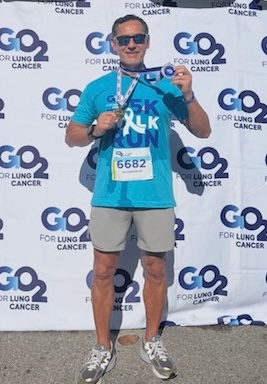
Earlier this year, Felipe heard from one of the runners from that half marathon where his symptoms first appeared. Now approaching 80, that same runner, Dan, was preparing to complete another half marathon, this time after his own cancer diagnosis.
On May 17, 2026 Felipe joined Dan for that race.
The moment felt full circle in a way he couldn’t have imagined years ago, when he was struggling to understand what was happening in his own body. To run alongside this man again after everything they’ve both been through seemed almost surreal.
For Felipe, this kind of real, human, and hard-earned connection is what it’s all about.
Looking ahead
Today, Felipe continues to train, build, and connect, drawing directly from his experience with lung cancer. He’s also focused on reaching more people, especially those navigating the uncertain space between treatment and whatever comes next.
He still undergoes regular scans, and there is still uncertainty. But his relationship with that uncertainty has changed. Instead of waiting for answers, he focuses on what he can control: how he trains, how he eats, and how he shows up each day.
For Felipe, surviving was never meant to be the end of the story. It was the beginning of a different experience, one rooted not just in getting through, but in moving forward with intention.
Because for him, the real question isn’t whether you survive. It’s what you do next.
A lung cancer diagnosis can bring a lot of questions, emotions, and uncertainty. GO2 for Lung Cancer's free HelpLine connects you with trained specialists who can provide support, answer questions, and help you find resources along the way. Whether you're newly diagnosed, in treatment, or navigating survivorship, you don't have to face it alone.
Call us at 1-800-298-2436 or email support@go2.org to learn more.